Wetlands Gulper
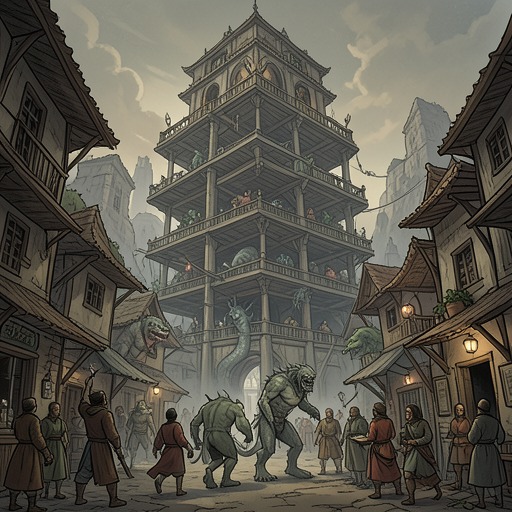
The Legend of William OhWetlands Gulper is a large amphibious predator associated with shallow wetlands, ponds, and running water. Its defining trait is not a mouthful of claws or teeth but a powerful, sticky tongue capable of seizing prey, dragging it underwater, and drowning it. In the economy of the Tower, that anatomy makes the creature more than a monster: it is a source of advancement materials and a piece of marketable biological equipment.
Habitat and Classification
Wetlands Gulper appears beside a tiny creek that feeds into a pond, with a raised patch of land and water-grass at the pond’s center. Its presence is first inferred from a single submerged foot roughly a foot across, an apparently small detail that becomes alarming once the creature’s true scale is recognized. The surrounding water provides the gulper with concealment and gives its hunting method a decisive advantage: prey can be pulled from the bank and drowned before it has a chance to fight on solid ground.
The System classifies the creature as a source of Earth, Water, Slime, and Tongue-based Abilities for the Aspirant’s available Class choices. Each level associated with Wetlands Gulper provides 1 Strength, 1 Resistance, and 1 Acuity. This combination explains why the creature attracts more than ordinary hunters. Its remains have practical value to Aspirant potters, farmers, and wealthy Lotharios, creating demand that links its ecology to both material production and social consumption.
Predation and the First Hunt
William Oh and Ben discover the gulper while moving quietly toward the sound of water. Ben identifies the submerged foot, and William follows its orientation to the lump of land in the pond’s center. Once they recognize the animal, they immediately calculate its economic value: a creature of that size might be exchanged for a worthwhile Sacrifice or perhaps a Relic. The calculation is inseparable from the danger, however, because approaching it in the water would expose them to the very tactic that makes the gulper formidable.
The Wetlands Gulper prefers to drag prey underwater with its tongue rather than tear it apart with sharp claws or teeth. William therefore devises an improvised countermeasure that turns the surrounding vegetation into a trap. He lashes himself to the top of a tree with his sling, then thrashes to attract the monster’s attention while Ben prepares to shoot. The plan succeeds in its central purpose: the gulper erupts from the pond and fires a tongue twenty feet long, instantly ensnaring William and hauling him toward the water.
The tree transforms that attack into a restraint. As the tree bends backward, it leaves the confused Wetlands Gulper dangling above the water’s edge by its own tongue, allowing Ben to use the suspended creature as a target. The tactic is effective but brutally miscalculated. The sling rope around William’s waist bears roughly five hundred pounds of pressure, crushing his midsection and threatening to tear him in half while the animal struggles. The kill takes three agonizing minutes, and Ben does not approach to cut the tongue free until the enormous toad has stopped twitching.
Value, Trade, and Cost
The tongue is the most immediately profitable part of the kill. The stated rate is 5 silver per foot of tongue, and Ben estimates that the trophy brings them about 80 silver. He further calculates that the tongue alone could buy half a dozen Sacrifices. The figure makes the Wetlands Gulper a striking example of the Tower’s resource logic: danger, anatomy, and cash value are fused, and a successful hunt can convert a single attack organ into the materials needed for a Class Trial.
The profit is not the same as disposable wealth. William’s bruised waist leaves him nauseated and effectively finished for the day, while the market imposes its own deductions. When he later purchases a spirit turtle Sacrifice, the merchant charges 20 silver, more than half the amount earned from the tongue. William realizes that retail value is unavailable to a hunter who has neither preserved the material personally nor established a shop capable of finding customers willing to pay. Even so, placing the Sacrifice in his satchel leaves him two-thirds of the way toward his immediate goal on the first day.
The encounter thus presents Wetlands Gulper as both predator and economic instrument. Its tongue nearly kills William, then finances his progression; the same body part is simultaneously a weapon, a trophy, and a commodity. The creature’s importance lies in that conversion, not in a continuing personal role after the hunt. It establishes the practical grammar of survival in which monsters are assessed by their abilities, their harvestable parts, the risks of extraction, and the advancement those parts can purchase.